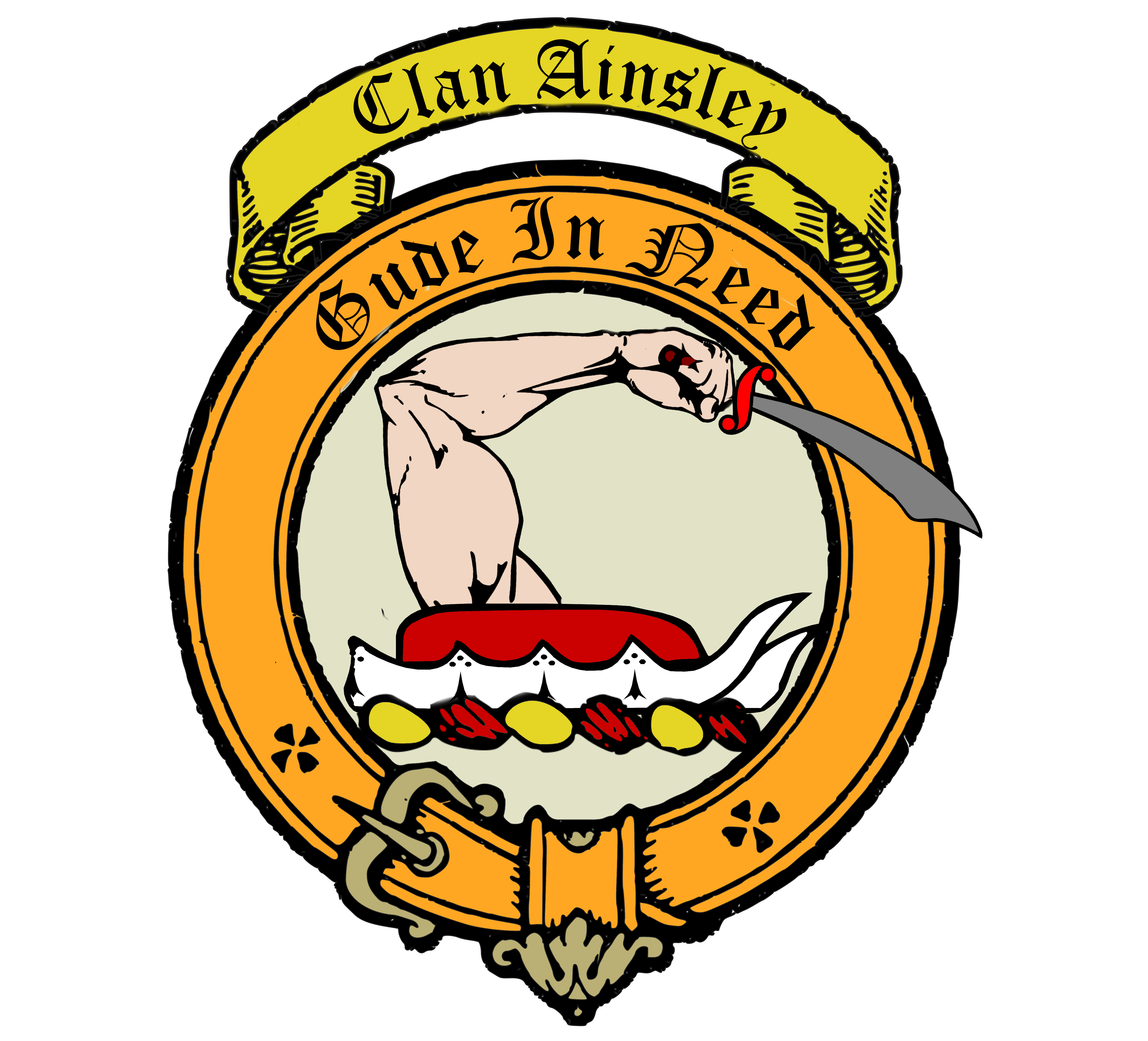
Ainsley Clan Crest
|
|
CREST: Issuing out of a cap of maintenance a naked arm embowed grasping a scymitar all Proper MOTTO: Gude in need TRANSLATION: Good in need VARIATIONS: Ainslie |
| The surname Ainsley has a long history, both in Scotland and England. Before the Norman Conquest, the Saxon lords of Annesley in Nottinghamshire held significant estates, but they fled to Scotland to escape the invading forces of William the Conqueror and were welcomed by King Malcolm III. They soon established themselves in the area around Dolphinstone. | |
|
Purchase @ Redbubble |
|
| William Ainsley, a canon of Glasgow Cathedral, witnessed a charter by Walter, Bishop of Glasgow, around 1208. In 1221, Thomas Ainsley was one of the mediators appointed to resolve a dispute between the monks of Kelso and the bishopric of Glasgow. Sir Aymer Ainsley was a Borders knight sent to negotiate with the English to settle the borders in 1249. There are two references to the family in the Ragman Roll, which listed those who submitted to King Edward I of England in 1296: John de Anesleye of Roxburghshire and Johan de Anesley of Cruwfurt in Laarkshire.
Robert Ainsley, Baron of Dolphinstone, accompanied his cousin Patrick, Earl of Dungar and March, on a crusade to the Holy Land between 1248 and 1254. It is believed that the Laird of Dolphinstone, who pledged loyalty to King Edward I, was John, the son of the crusader. The Ainsleys were opposed to Robert the Bruce in his quest to win the Scottish Crown, and their estates were seized as a result. However, their fortunes were restored when William Ainsley, who married Helen Kerr (of the family from which the present Duke of Roxburgh descends), became a favorite of King Robert II. The Ainsleys secured their status through strategic marriages with other prominent Border families, including the Pringles, Douglases, Homes, and Kerrs. Marjory, daughter of John Ainsley, married Mark Kerr of Cessford, a warrior known as the “Terror of the Borders.” He was killed at the Battle of Pinkie in 1547. Robert Ainsley, a lawyer who would become a friend and confidant of the poet Robert Burns, was born on January 13, 1766. He met Burns in Edinburgh in the spring of 1787 and later visited him at Ellisland, where he was given a manuscript copy of Tam o’ Shanter, which he presented to the writer Sir Walter Scott. One of his brothers, Sir Whitelaw Ainsley, was a medical superintendent of the Southern Division of India and the author of a work on Indian native medicine. He was a regular contributor to the Edinburgh Magazine and wrote several plays. Sir Robert Ainsley was the British ambassador to the Ottoman Empire at Constantinople from 1776 to 1792, and served as a Member of Parliament. He was created a baronet in 1804 and is now best remembered for his three volumes of drawings and sketches of Egypt. The Ainsley coat of arms alludes to their early crusading exploits, and members of the family have also held high military rank, including General Charles Ainsley, who commanded the 93rd Highland Regiment, known as the “Thin Red Line,” at the Battle of Balaclave in 1854. The Ainsleys were also known for their legal expertise, and David Ainsley of Costerton, who died in 1900, left a fortune from his legal practice to build the Astley Ainsley Hospital in Edinburgh. There is a memorial to the Ainsley family on the wall of the South Leith Parish Church. |
|